The price of reaching a fixed AI capability has fallen ~1,000× since 2021 — but the frontier is only ~25× cheaper. Why both are true, what one dollar buys today, and what it means for you.
“Artificial intelligence keeps getting cheaper” — that sentence is true and misleading at the same time. True: the price of reaching a fixed level of capability has fallen roughly a thousandfold since 2021. Also true: the best model money can buy is only about twenty-five-fold cheaper. Cheap AI is real — it is simply always about two years behind the frontier. Understand that split and you understand the whole economics behind the AI boom.
Updated: August 2026 · Data from a16z, Epoch AI and the Stanford AI Index.
Then vs. now: price per 1M tokens
To reach the same capability — US dollars, log scale. Hover a row (or tap it) for details.
Pick a row for the exact prices, dates and factor.
Two measured points per row, not a trajectory. Data: a16z “LLMflation”, Epoch AI · chart: techpill.de
Two prices you must not confuse
Behind the question “is AI getting cheaper?” hide two completely different prices. One is the price of a given capability: what does it cost to run a model that reliably clears a fixed bar — say, the knowledge test GPT-3 once barely passed? That price is falling breathtakingly fast. The other is the price of the frontier: what does the best model available right now cost? That price barely moves.
The reason is simple: the frontier does not stand still. The moment a top model ships, it becomes the new benchmark — and costs roughly what the previous top model did. A capability that was expensive yesterday, by contrast, slides into ever-cheaper models year after year. Both statements — “AI got a thousand times cheaper” and “the best model stays expensive” — are true at once. They just measure two different things.
1,000× cheaper: the GPT-3 case
The most striking example comes from the venture firm a16z, which coined the term “LLMflation” for it. When GPT-3 became publicly available in November 2021, it was the only model to reach a score of 42 on the MMLU knowledge test — at roughly $60 per million tokens. Three years later, a tiny open model (Llama 3.2 3B) cleared the same bar for about $0.06 per million tokens. That is a factor of 1,000 — or, put differently, roughly ten times cheaper, year after year after year.
The reading matters: this is not a single model getting a price cut, but the cost of reaching a capability level at all. The cheapest model that still clears the bar keeps getting cheaper. That is what makes the number so powerful — and so easy to misread if you confuse it with the price of the latest flagship.
The numbers at a glance
All the price points in one place — measured values, not a continuous curve. “Level” means the cheapest model that still matches the reference model’s benchmark.
Capability level
Window
Start price
Today
Factor
GPT-3 level
Nov 2021 → Nov 2024
$60
$0.06
1,000× cheaper
GPT-3.5 level
Nov 2022 → Oct 2024
$20
$0.07
285× cheaper
GPT-4 level
Mar 2023 → 2026
$30
$0.40
75× cheaper
Frontier flagship
2020 → 2026
$60
$1.25–15
~25× cheaper
Price per 1M tokens (US dollars). Sources: a16z “LLMflation”, Epoch AI. The frontier value is a range across major providers.
What one dollar buys
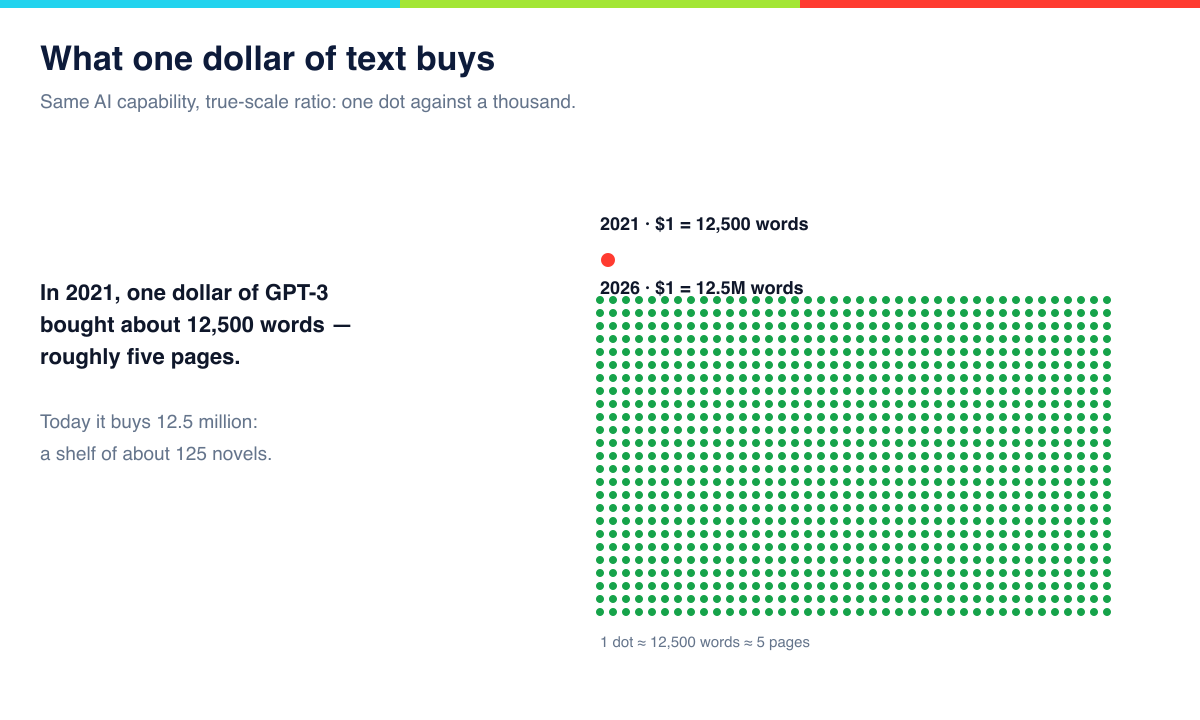
Translated into something tangible: in 2021, one dollar at GPT-3 level bought roughly 12,500 generated words — about five pages. Today the same dollar at the same capability buys around 12.5 million words — a shelf of about 125 novels. The graphic below shows the ratio at true scale: a single dot against a thousand.
One dot equals about 12,500 words. In 2021 it was exactly one; today it is a thousand — at the same capability.
The decline is uneven
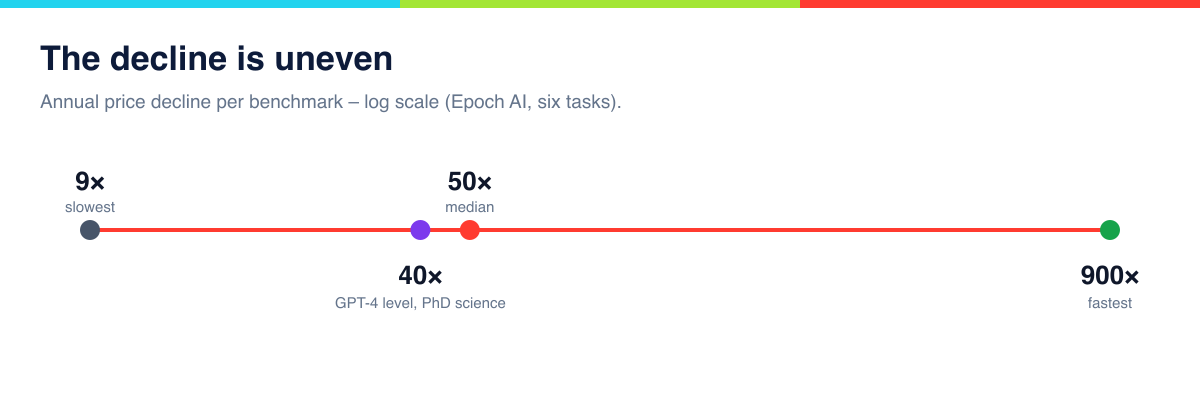
As clear as the trend is, it is unevenly spread. The research institute Epoch AI measured the price decline across six benchmarks and found enormous differences: depending on the task, prices fell between ninefold and nine-hundredfold per year. The median sits at around 50× per year; for GPT-4 level on hard science questions it was roughly 40×.
Annual price decline ranges from ninefold to nine-hundredfold — depending on how hard the task is.
The rule of thumb behind it: simple, well-bounded tasks get cheap fastest, because small, efficient models soon solve them easily. The hardest tasks — deep reasoning, expert-level knowledge — stay expensive longer, because they still need large models.
Faster than Moore's Law
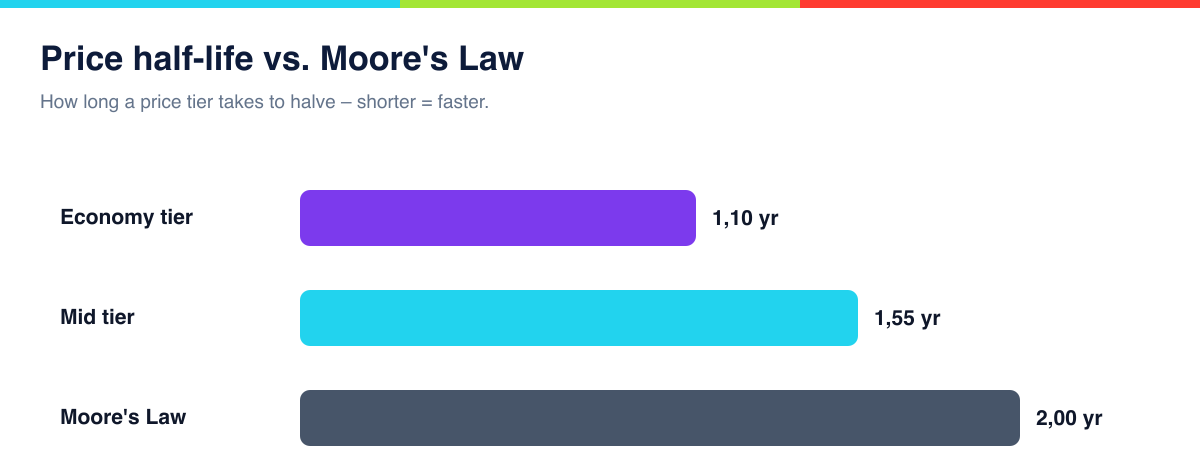
To put the speed in context, compare it with the famous Moore's Law, under which computing power roughly doubles every two years. With AI prices, a cheap price tier halves in just over a year — the fastest tiers in a matter of months.
Shorter bar = faster decline. AI price tiers halve faster than computing power under Moore's Law.
a16z puts it bluntly: nothing in computing history has ever fallen in price this fast — not compute in the microprocessor era, not bandwidth during the dotcom boom. Measured against a fixed capability, the AI price collapse is historically unprecedented.
What drives the decline
That a fixed capability gets cheap so fast is no accident, but the result of several forces acting at once:
Smaller, smarter models. Through techniques like distillation, the knowledge of large models is packed into much smaller ones. A 3-billion-parameter model today beats a giant from 2021 — at a fraction of the compute cost.
More efficient execution. Quantization (computing with fewer decimal places), better batching and optimized inference software squeeze far more out of the same hardware.
Better hardware. Each new generation of AI accelerators lowers the cost per token on top of everything else — the classic hardware march adds to the effect.
Competition and open models. Freely available open-weight models push prices down: once a capability is open source, its market price falls toward the cost of running it.
Economies of scale. With sheer request volume, unit costs drop — and large providers pass part of that on as price cuts.
Together these forces make reaching a known level dramatically cheaper every year. They also explain why the frontier barely benefits: the newest, largest model uses exactly these efficiency gains to do more — not to get cheaper at the same capability.
Why the frontier stays expensive
And here is the flip side. The frontier model of the day — the absolute best a provider sells at moment X — has become only about 25× cheaper over six years. For comparison: in the three years a fixed capability became a thousand times cheaper, the frontier barely budged.
The reason is the same as above, read the other way: whoever always wants the newest is buying a target that keeps running away. Today's flagship costs roughly what the flagship did years ago — measured by what it can do, that is enormous progress; measured by the price tag, it is barely cheaper. Bluntly: if you must always stay at the front, you pay almost 2020 prices. If you can tolerate a two-year lag, you pay almost nothing.
What it means for you
From this split follows a surprisingly practical rule — whether you use AI personally, build products with it, or run a company:
Do you really need the frontier? For the absolute hardest tasks — edge cases of reasoning, highly specialized expertise — there is no way around the expensive flagship. That is the price of standing at the very front.
Or is “yesterday's excellent” enough? For the vast majority of real applications — summarizing, translating, classifying, customer chat, code suggestions — a model that was state of the art a year or two ago is plenty. And that costs a fraction today.
The real question is therefore no longer “can I afford AI?” but “how much lag can my product tolerate?” Deliberately staying two years behind the frontier cuts costs dramatically with barely any loss of quality.
For developers this means concretely: don't reflexively wire in the most expensive model — check which cheaper model already handles the task reliably, and pass only the genuinely hard cases up to the frontier. That tiering is the lever that brings the thousandfold price decline into your own project.
A worked example
How big the difference is in practice is clear from a simple calculation. Imagine an app that generates about 100 million words a month — for summaries or customer replies, say. That is roughly 133 million tokens.
2021, at GPT-3 level: at $60 per million tokens, that would be about $8,000 a month — the end of many ideas.
2026, same level: at $0.06 per million tokens, it is about $8 a month.
A cost block that could crush a business model becomes a rounding error. That collapse explains why AI features are suddenly appearing everywhere: what used to be unaffordable now costs less than lunch. If that same app always picks the current flagship, however, the bill stays many times higher — the price of always being at the front.
Winners — and who pays
The uneven decline noticeably reshuffles the deck. The winners are everyone who buys a solid, “yesterday” capability cheaply: app developers, small firms, tinkerers, and ultimately end users who get more and more AI features almost for free. Whoever tiers cleverly and sends only the hard cases to the flagship cuts costs sharply.
Under pressure are two groups. First, anyone who must operate at the frontier — there prices stay high, because the best model is a moving target. Second, the providers themselves: a model that is state of the art today becomes cheap commodity in two years. A model's value decays fast, which makes the race for the next flagship ever more expensive and risky.
And the future?
Forecasts warrant caution, but the direction is clear: as long as models keep getting more efficient and competition stays fierce, the price of a fixed capability should keep falling — until, for many tasks, it barely matters. The price of the frontier hinges on a different question: how fast and how expensively new flagships appear, and whether competitive pressure squeezes margins. Two things look likely: catching up becomes nearly free, and the roughly two-year gap between frontier and cheap tier remains the decisive figure for now.
Methodology and limits
A few notes so the numbers are read correctly. The values combine published list prices with capability-matched cost estimates from several sources (a16z “LLMflation”, Epoch AI, Stanford AI Index). They are not a single, continuous price curve: each row of the big chart is a start point and a current point, and nothing is claimed about the path between them.
“Level” means the cheapest model that still reaches the reference model's benchmark — not the same model over time. Input and output prices, as well as blended per-token measures, are not strictly interchangeable; the orders of magnitude, however, are stable across all serious analyses. The frontier price, finally, is a range across the major providers, not a single value — models are not freely interchangeable in practice, even at equal benchmark scores.
Everything at a glance
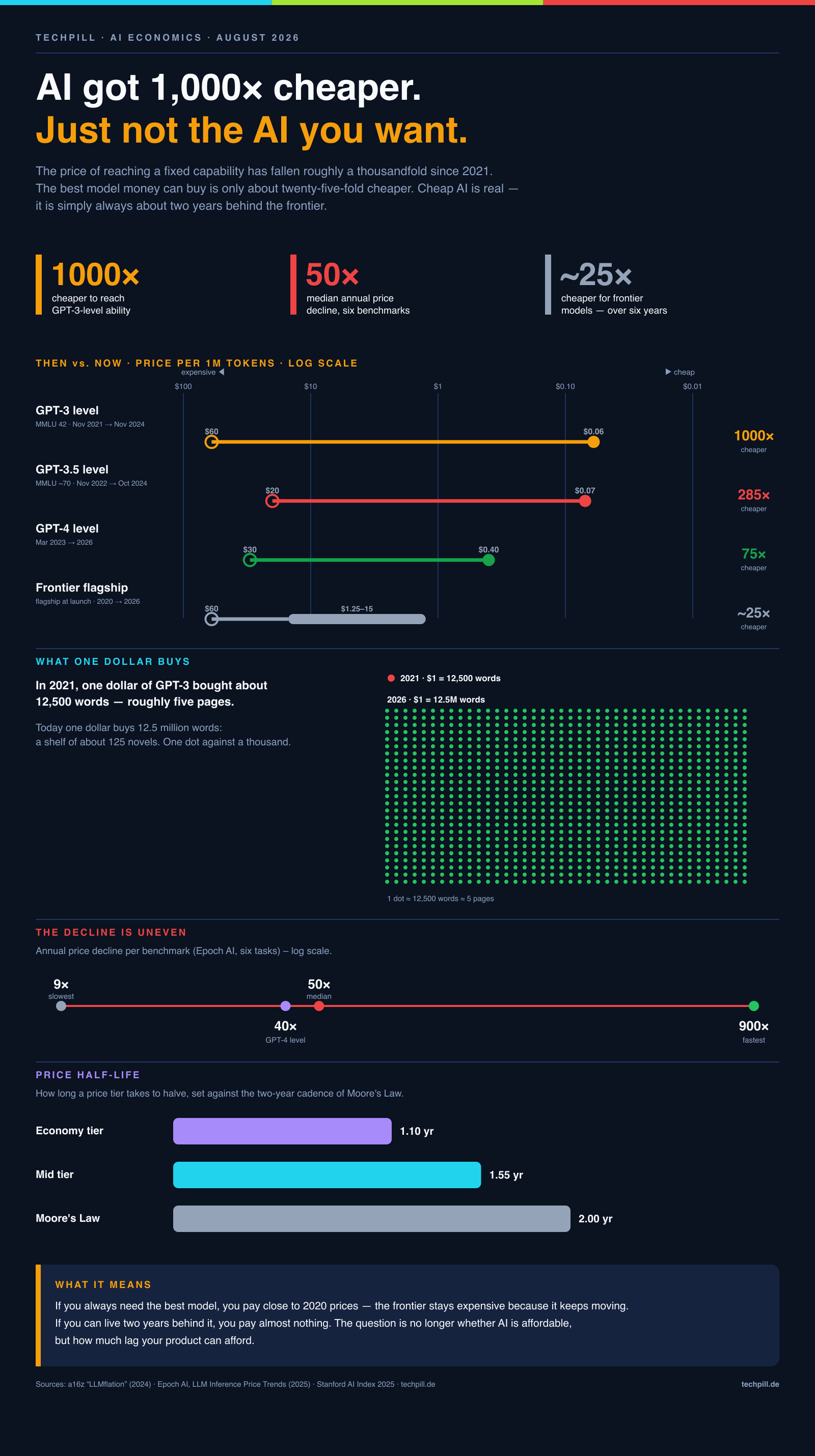
The whole story in one graphic — from the key numbers through the price decline per level to the price half-life. Free to share and embed, with attribution.
The complete overview: the AI price collapse 2021–2026 at a glance. Data: a16z “LLMflation”, Epoch AI, Stanford AI Index.
Frequently asked questions
Is AI getting cheaper or not?
Both — depending on what you mean. For a fixed capability, AI has become about 1,000× cheaper since 2021. The best model of the day is only about 25× cheaper. Cheap AI is real, but it always sits about two years behind the frontier.
What does “per million tokens” mean?
Tokens are the text building blocks models compute in (roughly: one token ≈ 0.75 words). Prices are usually quoted per million tokens. One million tokens is about 750,000 words.
Why does the price fall at such different rates?
Because simple tasks are soon handled by small, efficient models (fast decline), while the hardest tasks still need large models (slower decline). Hence the range of 9× to 900× per year.
Is this price decline really unique?
Measured against a fixed capability, yes: according to a16z, nothing in computing history has ever got cheaper this fast — faster than compute in the microprocessor era or bandwidth in the dotcom boom.
Does this mean AI use will soon be free?
For a fixed, “yesterday” capability, the price does approach almost nothing. The frontier stays expensive as long as it keeps moving. So catching up becomes free, not being out in front.
What does it mean for companies using AI?
The key question is how much lag a product can tolerate. If you don't strictly need the frontier, choosing a slightly older, cheaper model saves enormously with barely any loss of quality.
Can the trend reverse?
The decline at a fixed capability should continue as long as models get more efficient. The frontier price depends on how fast and how expensively new flagships arrive — and whether competition compresses margins.
Bottom line
The headline “AI got 1,000× cheaper” is true — just not for the AI most people have in mind. The price of reaching a given capability has imploded, while the best model of the day stays expensive because it is a moving target. For you it comes down to one question: do you really need to be at the front — or is the best of the day-before-yesterday enough, at a fraction of the price? That answer now decides your AI bill more than any price list.
Sources
a16z (Andreessen Horowitz): “Welcome to LLMflation — LLM inference cost is going down fast” (2024)
Epoch AI: “LLM inference prices have fallen rapidly but unequally across tasks” (2025)
Martin Frost ist Gründer und Herausgeber von TechPill. Er schreibt über Smartphones, Apps, digitale Dienste und verständliche Lösungen für den Technik-Alltag.
Kommentare
Noch keine Kommentare. Schreib den ersten und teile deine Erfahrung oder Frage.
Der Preis, um ein festes KI-Können zu erreichen, ist seit 2021 rund 1.000× gefallen – die Spitze aber nur etwa 25×. Warum beide Aussagen stimmen, was ein Dollar heute kauft und was das für dich bedeutet.
OpenAI halbiert die Preise für neue GPT-6-Modelle, Apple legt sein KI-Wearable auf Eis und Siri AI lässt sich am Mac nur mühsam entfernen. Ein Überblick.
Bereits 2020 haben wir viele Laptops gesehen, welche die Industrie revolutioniert haben. Angefangen bei dem bahnbrechendem MacBook Air mit Apples M1-Chip über den...
Instagram-Konto gehackt? So sicherst du Passwort, E-Mail, Zwei-Faktor-Authentifizierung, Geräte und verknüpfte Apps oder stellst den Zugriff wieder her.
Welche Powerbank darf mit ins Flugzeug? Die besten Modelle für iPhone, iPad und Laptop mit 100-Wh-Regel, Wh-Rechner, Handgepäck-Check und Kaufempfehlungen.