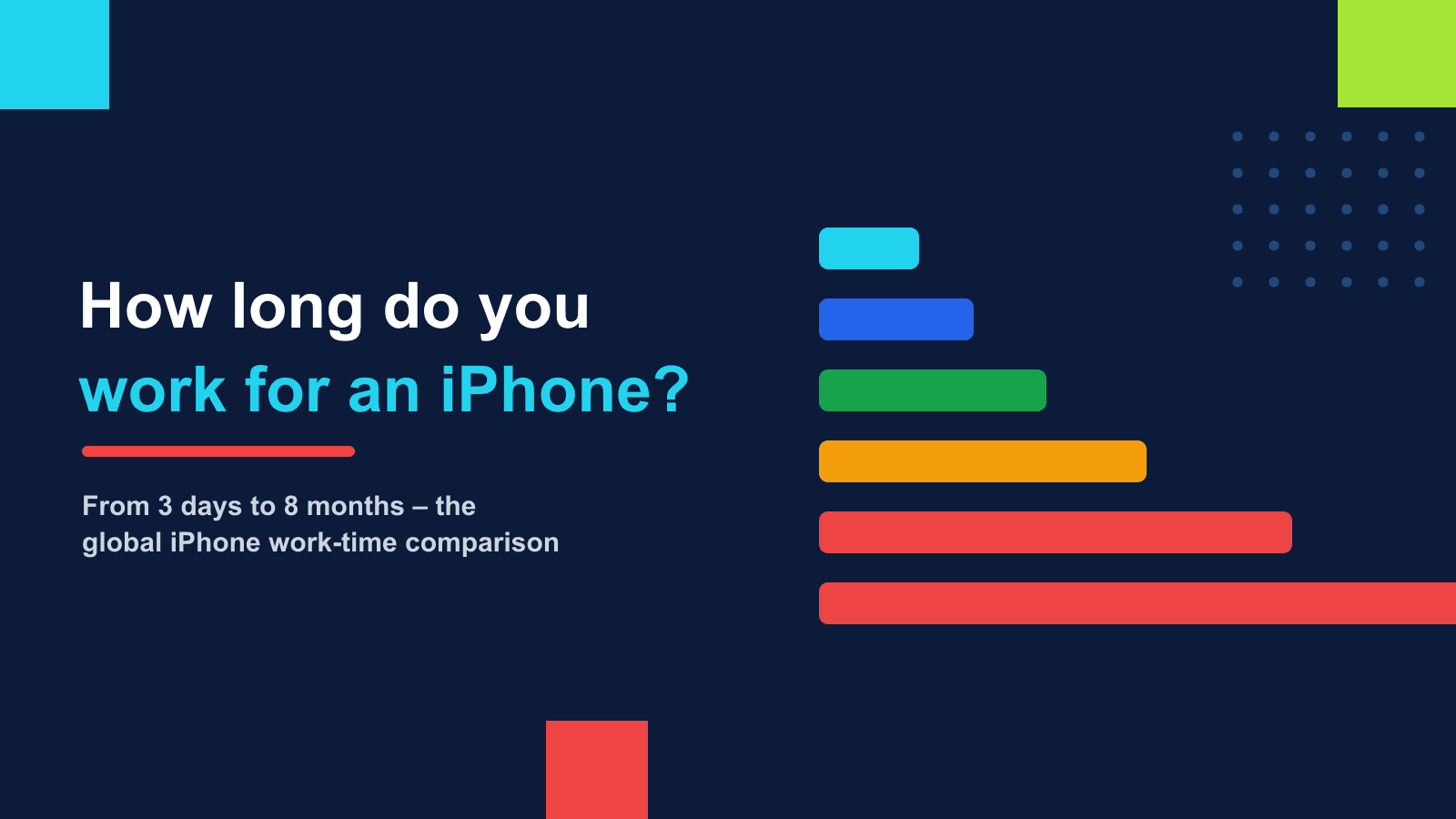
An iPhone 17 Pro costs roughly the same everywhere in the world — but not the same amount of life. In Luxembourg and Switzerland, three working days are enough. In the United States, four. In India, it takes 160 — around eight months of work for the very same device. We turned the data from the iPhone affordability index into charts that make the global gap visible in seconds, and explain in depth what drives it: the role of wages and taxes, how it has shifted over the years, and how you can lower your own "work time per iPhone."
What the numbers show
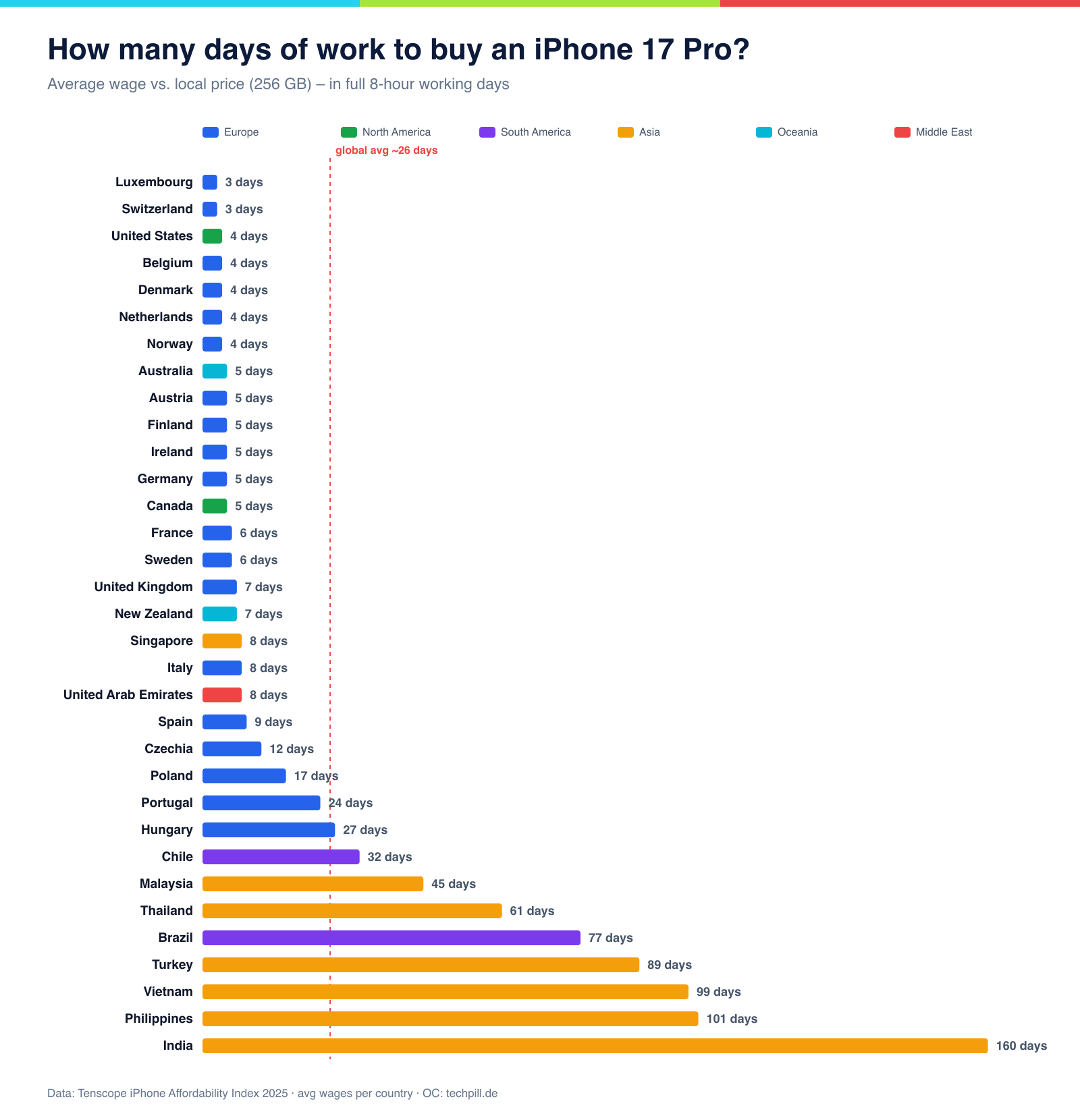
The pattern is unmistakable: in wealthy countries the iPhone is a matter of a few working days. Luxembourg and Switzerland lead with three days, followed by the United States, Belgium, Denmark, the Netherlands and Norway at four. A whole block — the United States' northern neighbour Canada, plus Germany, Austria, Finland, Ireland and Australia — lands at five days.
From the middle of the table onward, it tips over: Spain needs nine days, Poland 17, Portugal 24 and Hungary 27. And at the bottom, a consumer product turns into a months-long savings project — 77 days in Brazil, 89 in Turkey, 99 in Vietnam, 101 in the Philippines and a staggering 160 working days in India. Between rank 1 and rank 33 there is a factor of more than 50: the same technology, 50 times the time investment.
A look at the world regions
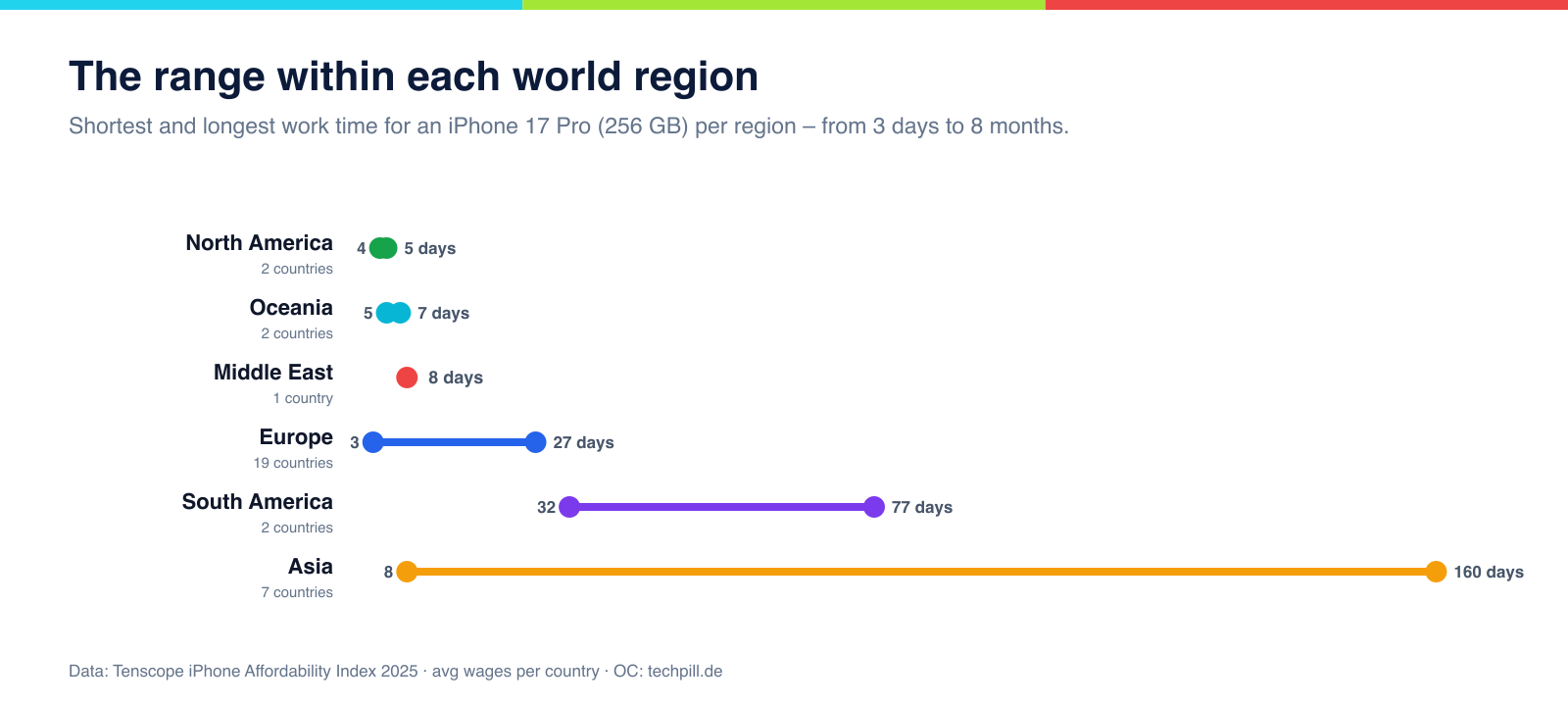
The gap becomes even clearer when you look at entire regions rather than single countries. North America and Oceania sit close together — everything here falls between four and seven days. Europe, by contrast, is split: from the three-day leader Luxembourg to Hungary's 27 days, it spans almost the entire range of the wealthy world. And Asia stretches from eight days in rich Singapore all the way to India's 160 — a continent that contains both extremes at once.
The full ranking: all 33 countries
From the cheapest to the most expensive country, measured in full 8-hour working days for an iPhone 17 Pro (256 GB):
| # | Country | Working days | Region |
|---|---|---|---|
| 1 | Luxembourg | 3 | Europe |
| 2 | Switzerland | 3 | Europe |
| 3 | United States | 4 | North America |
| 4 | Belgium | 4 | Europe |
| 5 | Denmark | 4 | Europe |
| 6 | Netherlands | 4 | Europe |
| 7 | Norway | 4 | Europe |
| 8 | Australia | 5 | Oceania |
| 9 | Austria | 5 | Europe |
| 10 | Finland | 5 | Europe |
| 11 | Ireland | 5 | Europe |
| 12 | Germany | 5 | Europe |
| 13 | Canada | 5 | North America |
| 14 | France | 6 | Europe |
| 15 | Sweden | 6 | Europe |
| 16 | United Kingdom | 7 | Europe |
| 17 | New Zealand | 7 | Oceania |
| 18 | Singapore | 8 | Asia |
| 19 | Italy | 8 | Europe |
| 20 | United Arab Emirates | 8 | Middle East |
| 21 | Spain | 9 | Europe |
| 22 | Czechia | 12 | Europe |
| 23 | Poland | 17 | Europe |
| 24 | Portugal | 24 | Europe |
| 25 | Hungary | 27 | Europe |
| 26 | Chile | 32 | South America |
| 27 | Malaysia | 45 | Asia |
| 28 | Thailand | 61 | Asia |
| 29 | Brazil | 77 | South America |
| 30 | Turkey | 89 | Asia |
| 31 | Vietnam | 99 | Asia |
| 32 | Philippines | 101 | Asia |
| 33 | India | 160 | Asia |
The United States: four days — but not for everyone
At four working days, the US is near the very top of the table, just behind Luxembourg and Switzerland. Part of that advantage is a quirk of how prices are shown: US sticker prices typically exclude sales tax, which is only added at the register and varies by state. Add it in and the real out-the-door figure creeps up a little.
The bigger caveat is the word "average." The figure is based on the average wage — a statistical value that doesn't match many people's reality:
- On the federal minimum wage, it takes far longer — easily two to three times as many working days.
- At the median income, which sits below the arithmetic mean, the number shifts upward, because a small group of high earners pulls the average up.
- Gross versus take-home pay matters too: less lands in your pocket after tax, so it takes longer in practice.
The order of magnitude — "around a working week for the average earner, more for lower incomes" — holds across all wealthy countries. What's striking is the gap to Switzerland: despite higher prices there, much higher wages mean the Swiss earn "enough" for their iPhone faster than almost anyone else.
Why are the differences so enormous?
The price of an iPhone varies far less across the world than incomes do. Two factors pull the gap wide open:
- Wages — the biggest lever. An average wage in Switzerland is many times an average wage in India or the Philippines, while the device costs almost the same. Because work time is the denominator in the calculation, every wage difference feeds straight through: halve the wage and the work time doubles.
- Taxes and import duties. In countries such as Brazil, Turkey and India, high import and consumption taxes make the iPhone more expensive still — sometimes 40 percent or more on top of the base price. This hits exactly the countries where wages are already lower: a double disadvantage.
India is a telling example: steep import duties on imported devices meet a goods-and-services tax and comparatively low average wages. That's precisely why Apple now builds a growing share of iPhones locally — domestic manufacturing sidesteps part of the import charges and lowers the final price. In Turkey, a weak and volatile currency adds to heavy taxation: because the iPhone is imported and priced in dollars, every drop in the lira makes it costlier. Brazil, meanwhile, is notorious for its stacked import, industrial and sales taxes, which have made electronics there among the most expensive in the world for years.
How this has changed over the years
People have asked "how long do I have to work for an iPhone?" since the very first model in 2007 — and the answer has shifted. In wealthy countries the iPhone has, measured in work time, generally become more affordable over the years: wages have risen, while the entry price of a new iPhone stayed remarkably stable for a long time.
At the same time, the top of the range has drifted upward. The most expensive model — once a single flagship, today a Pro Max with maximum storage — costs noticeably more in inflation-adjusted terms than the top model a decade ago. So whoever always wants "the best" iPhone works longer for it than they used to; whoever is happy with the solid standard model gets off comparatively cheaply.
Purchasing power, not the price tag
This is where the real value of the exercise lies: a price in dollars tells you little on its own. Only in relation to income does it become clear what a product really costs. A four-figure sum means something completely different to an average earner in the US than to someone facing the same nominal price in Manila or Mumbai.
What else could you get for that time?
The work-time perspective really lands when you translate it into life time. Four to five working days in a wealthy country — that's most of a working week, Monday to Friday, just for the phone. In India, 160 working days is roughly seven to eight months of work (at around 21 working days per month) — more than half a year of life for a single device.
That explains why the same product carries a completely different social meaning in different parts of the world: in rich countries the iPhone is an everyday object you replace almost casually. In many others it is a status symbol and an investment — one you save for over months, and use long and carefully as a result.
Base model, Pro or Pro Max — how much does it move the number?
Our charts show the iPhone 17 Pro with 256 GB. For a cheaper or more expensive model, all the values shift, but the ranking between countries stays similar:
- Base model (iPhone 17): noticeably less work time — in the US, on the order of around 20 working hours rather than several days for the Pro.
- iPhone 17 Pro Max with maximum storage: the most expensive jump — in low-wage countries, the extra work time quickly adds up to several hundred hours.
So if you want to keep the work time down, you have two big levers: the model and the storage. The storage upcharge in particular has always been high at Apple — often the most expensive "work hours per gigabyte" line item of all. Going from 256 to 512 GB costs more work time in many countries than an entire month of a phone contract.
How to lower your own iPhone work time
Even where the iPhone costs "only" a working week, it pays to be deliberate about that time. Four levers noticeably reduce the work hours per device:
- Pick the right model and storage. For most people, the standard model with mid-tier storage is plenty. The premium for a Pro Max and the largest storage is by far the most expensive part of the bill.
- Buy used or refurbished. A well-kept last-year model often costs a third less, with barely any everyday difference.
- Keep it longer. A device that costs you a working week should last as long as possible. The more years you use it, the less work time it costs per year — and iPhones receive software updates for many years. We looked at exactly how long in our guide on how long iPhones get updates.
- Don't upgrade every year. The year-on-year jump is usually small. Upgrading every three to four years roughly thirds your "iPhone work time" over the long run without really giving anything up.
Methodology and source
The figures come from the iPhone Affordability Index 2025 (Tenscope), which uses the same logic as the well-known annual iPhone-index studies: the local retail price of the iPhone 17 Pro with 256 GB (including the taxes usually applied locally) is divided by the average daily wage and converted into whole 8-hour working days.
An important caveat: these are average values. There are large income differences within every country, and whether you calculate with gross or net wages shifts the absolute numbers. Exchange rates, local discounts and carrier plans are left out too. The ranking and the order of magnitude of the differences are, however, very stable across all serious calculations — the index is a comparative yardstick, not a receipt. It's not meant for exact statements about individual households, but it is excellent for comparing purchasing power between countries.
Frequently asked questions
Why does the iPhone cost so much more, relatively, in poorer countries?
Because prices worldwide are relatively similar while wages are extremely different. On top of that, countries like India, Brazil and Turkey add high import and consumption taxes that make the device more expensive — exactly where people already earn less.
Is the iPhone really cheapest in the United States?
In pure work time, Luxembourg and Switzerland lead (3 days), with the US following at 4. Part of the US advantage comes from the fact that American prices are usually shown without sales tax — that's added at checkout and differs by state.
Which iPhone is the calculation based on?
The iPhone 17 Pro with 256 GB of storage, at each country's local retail price. For a cheaper base model all values would be lower, for a Pro Max with more storage higher — but the ranking between countries would stay similar.
How many working days is it in the US exactly?
Around four working days for the average earner. On the minimum wage it's substantially more, and lower-than-average incomes push it up further; gross versus take-home pay shifts the value as well.
Why does Apple build iPhones in India?
Among other reasons, to avoid high import duties. Locally manufactured devices aren't subject to the same import charges as imported ones — which lowers the domestic price and makes the iPhone somewhat more accessible there. It also reduces Apple's reliance on any single production location.
Is the iPhone getting more expensive or cheaper over time?
It depends on the model: in wealthy countries the entry model has, measured in work time, become somewhat more affordable over the years, while the top of the range (Pro Max, large storage) has drifted upward.
Is the iPhone index a serious measure of wealth?
As a rough, vivid indicator, yes — much like the Big Mac Index. It's not suited to exact statements about individual households, because it works with averages. For comparing purchasing power between countries, though, it is very telling.
How can I reduce the work time for my iPhone?
Through model and storage (standard model instead of Pro Max, a smaller storage tier), by buying used, and by keeping a device longer rather than upgrading every year. Each of these levers clearly lowers the work hours per iPhone.
Bottom line
The iPhone is a global product at an almost global price — but the world earns wildly different amounts. That's what makes the numbers so striking: the same technology sits behind a three-day purchase in Luxembourg and an eight-month project in India. If you want to know what a price tag really means, don't look at the number in dollars — look at how much life it represents. And for your own wallet: the more deliberately you choose model, storage and lifespan, the less work time your iPhone ends up costing you per year.